

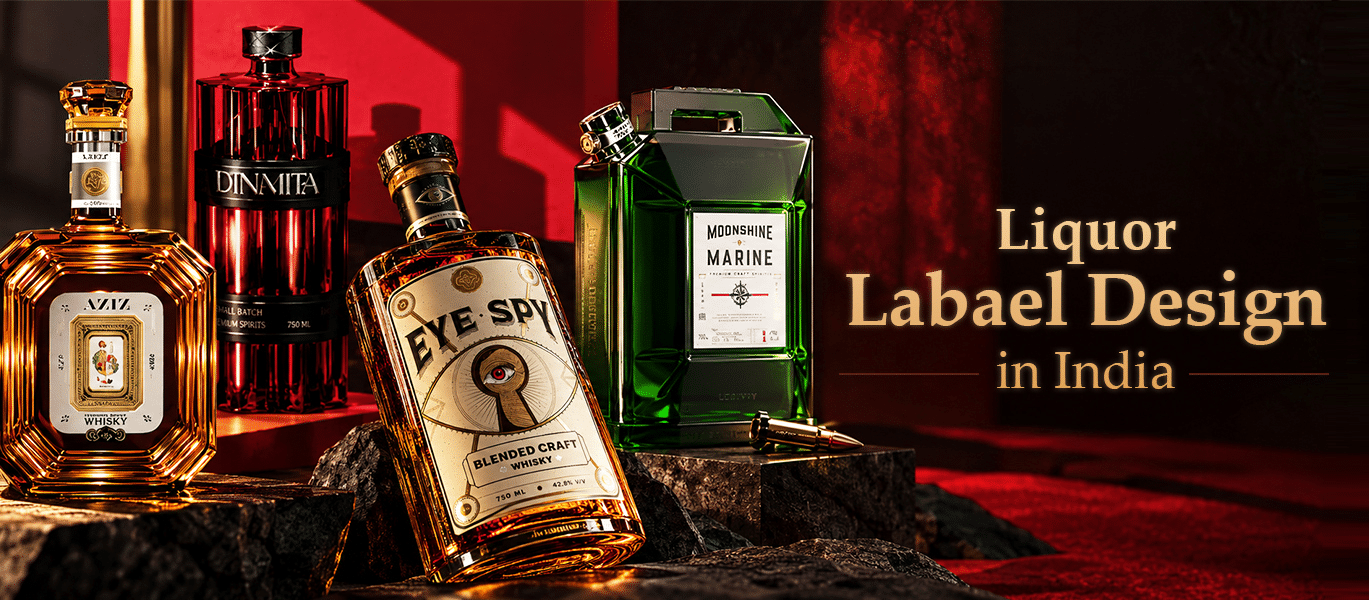
A spirits label in India has two jobs: it must win attention in a store where you cannot advertise freely, and it must pass a long list of regulations. Get the second part wrong and the first never happens, because the label will not be approved. This guide covers the liquor label rules in India that shape design decisions, so your creative work survives the approval process.
This article is a design guide, not legal advice. Always confirm current requirements with your regulatory consultant and the excise department of each state you sell in.
The three sets of rules your label must follow
A liquor label in India answers to three authorities at once:
- FSSAI, under the Food Safety and Standards (Alcoholic Beverages) Regulations, 2018, which came into force on 1 April 2019
- Legal Metrology, which governs declarations on any packaged commodity
- State excise departments, which approve labels and set their own additional requirements
What FSSAI requires on a liquor label
- Alcohol content, declared as a percentage of alcohol by volume
- The statutory health warning: "CONSUMPTION OF ALCOHOL IS INJURIOUS TO HEALTH. BE SAFE-DONT DRINK AND DRIVE", in English or the local language, in letters no smaller than 3 mm
- No nutritional information or health claims on the label
- An allergen warning where sulphur dioxide exceeds 10 mg per litre
- Extra details for wine, including country of origin and grape or fruit variety
- Compliance with the import regulations for imported spirits
What Legal Metrology adds
Like any packaged product, a bottle needs the manufacturer or bottler's name and address, net quantity, maximum retail price, month and year of manufacture or packing, and consumer care details. These take more space than most first drafts allow for.
State excise: the step brands underestimate
Each state registers and approves labels separately, and some ask for specific placements, state-specific markings or security features. A label that sells in one state may need an adapted version for the next. Plan for state variants from the start rather than squeezing them in later.
How good spirits label design works within the rules
Compliance takes up real estate. The skill is in keeping the mandatory text legible while the brand still leads.
- Design the back label first. Map every mandatory element at its true size before designing the front. This avoids the late scramble that ruins layouts.
- Let the bottle carry the brand. Glass colour, embossing, the closure and the neck can tell the story so the front label does not have to hold everything.
- Build a system for state variants. Fixed zones for state-specific details mean one master design adapts quickly.
- Use the story, not claims. You cannot make health claims, but you can tell a story. Our design for Aziz whisky uses a playing card, a crown cap and a coded "38" on the neck to carry a story of forbidden love, without a single claim.
- Test at shelf distance. Indian liquor stores often display bottles behind counters. Check the brand name reads from two metres away.
A pre-submission checklist
Before you send artwork for excise approval, run through this list:
- Statutory warning text is exact, in capitals, and at least 3 mm high
- Alcohol content is declared as % v/v
- No health or nutrition claims anywhere on the bottle, carton or neck label
- Manufacturer or bottler name and address, net quantity, MRP and date of manufacture are present
- Consumer care details are included
- State-specific details sit in the reserved zone for that state
- All text is legible at actual print size on the actual material
- Carton and gift box carry the same mandatory details as the bottle where required
Why liquor brands invest more in packaging
With direct advertising of alcohol restricted in India, the bottle does much of the work that media does for other categories. It is the advertisement, the shelf presence and the gift, all at once. That is why alcobev packaging design deserves more budget and more time than most other categories.
See how we approach this in our liquor and spirits packaging work, including Eye Spy whisky.
Frequently asked questions
Does the statutory warning have to be in English?
It can be in English or the local language, as long as it meets the minimum letter height of 3 mm.
Can a liquor label say "smooth" or "pure"?
Taste descriptors are common, but anything that reads as a health or nutrition claim is not allowed. Check wording with your consultant.
Do I need a new label for each state?
Often, yes. Each state approves labels separately, so build a master design with space for state-specific details.
Launching or redesigning a spirits brand? As a liquor packaging design agency in India, we design labels and bottles that pass approval and stand out on the shelf. Start a conversation.

No Comments.