

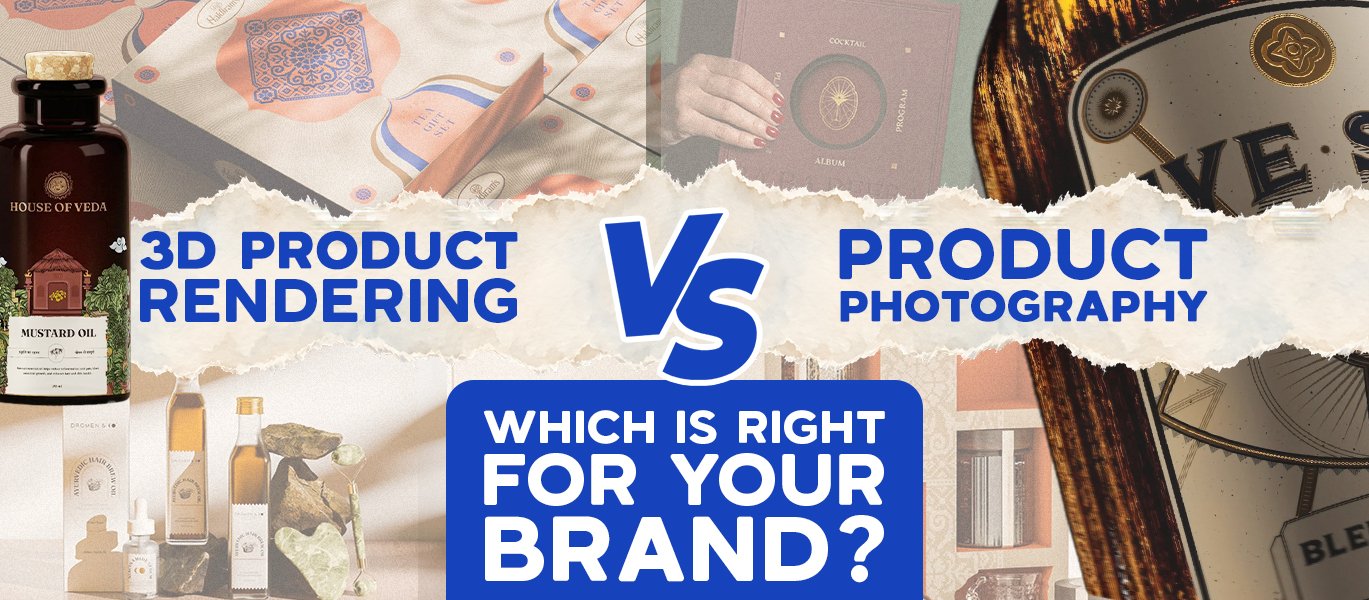
Every product launch needs visuals: website images, marketplace listings, social content, pitch decks and retail material. For years, that meant a photoshoot. Today, many brands use 3D product rendering instead, or a mix of both. This guide compares 3D render vs product photography so you can choose the right approach for your brand.
What is 3D product rendering?
A 3D render is an image created from a digital model of your product. The model is built from your packaging artwork and dimensions, then lit, styled and placed in any scene. Done well, renders are hard to tell apart from photographs. The same model can also be animated into video.
Side by side
| Factor | 3D rendering | Product photography |
|---|---|---|
| Needs a physical product | No, only artwork and dimensions | Yes, finished samples |
| Speed for new variants | Fast, change colours or labels digitally | New shoot for each variant |
| Scenes and backgrounds | Unlimited, including impossible ones | Limited by location and props |
| Consistency across a range | Perfect, same lighting every time | Varies between shoots |
| Food, texture and people | Harder to make fully natural | Natural and authentic |
| Animation and video | Built from the same model | Separate video shoot |
| Cost over time | Higher setup, lower cost per new image | Repeated cost for every shoot |
When 3D rendering wins
- Before the product exists. Launch visuals, investor decks and pre-orders can be ready while production is still underway. For Aziz whisky, 3D let the team approve the bottle and create launch images before tooling.
- Large ranges. If you have twenty flavours, one model with twenty label files beats twenty photo setups.
- Frequent updates. Seasonal editions and price-pack changes can be updated in hours.
- Hero shots that are hard to photograph. Splashes, exploded views, floating products and cutaways.
- Consistency. Marketplace grids look sharper when every image shares the same lighting and angle.
When photography still wins
- Food served on a plate, where real texture and steam matter
- Lifestyle content with people using the product
- Fabric, jewellery and finishes that customers want to see exactly as they are
- Restaurants and spaces, where atmosphere sells
The best answer is often both
Many brands use 3D for pack shots, listings and launch assets, and photography for lifestyle and food content. Our work for Uncle Jacks combined identity, packaging and 3D CGI to give the brand consistent visuals as it expanded across North India.
How the 3D process works
- Share artwork and dimensions. Final or near-final packaging files, plus the size and shape of the pack or bottle.
- Model building. The studio builds an accurate 3D model, including materials like glass, foil, matte paper or metal.
- Look development. Lighting and materials are tuned until the render matches the real finish.
- Scene and styling. The product is placed on clean backgrounds for listings, or in styled scenes for social and campaigns.
- Review and refine. You review stills and request changes, just like a photoshoot.
- Extend. The same model is reused for new variants, animations, AR and future campaigns.
A first set of renders usually takes one to three weeks, depending on how many products and scenes you need. After that, new variants are much faster because the model already exists.
What to ask a 3D product rendering service
- Can I see renders next to photos of the real product?
- Will I own the 3D model for future use?
- Can the same model be used for animation and AR?
- How are label changes and new variants priced?
Frequently asked questions
Are 3D renders allowed on Amazon and Flipkart?
Marketplaces generally accept renders for the main image as long as they accurately show the product. Check each marketplace's current image guidelines.
How realistic are 3D renders?
A skilled studio can produce renders that most buyers cannot tell apart from photographs, especially for packaged products.
Do I need 3D if I already have packaging design?
The two work best together. A packaging agency with in-house 3D can show your pack in context before it is printed.
Need launch visuals for a new product? Explore our 3D product rendering and CGI services or send us your pack artwork.

No Comments.