

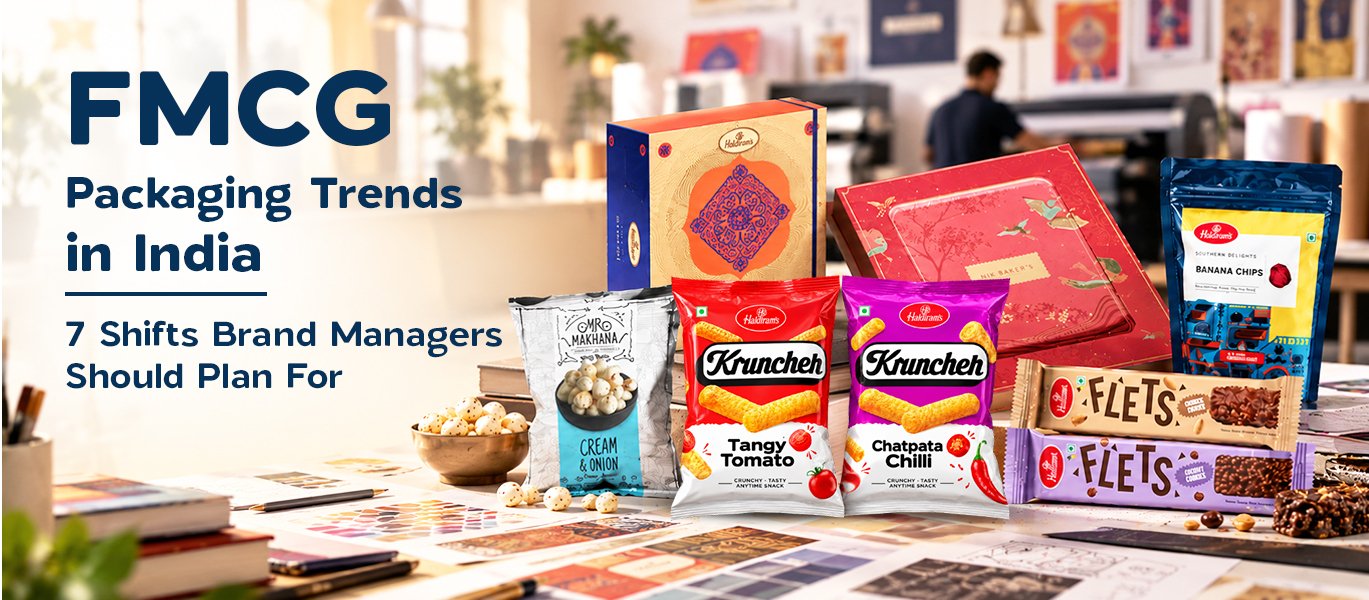
Indian FMCG packaging is changing faster than at any time in the last decade. How people shop, what they expect and what regulators require are all shifting at once. These are the seven FMCG packaging trends in India that brand managers should plan for in their next redesign cycle.
1. Design for the thumbnail first
Quick commerce apps have changed where many purchase decisions happen. On an app, your pack is a small square image in a grid of competitors. Brand name, product type and variant need to read at that size, without zooming. Packs designed only for the physical shelf often lose their key information on screen.
What to do: Review every SKU as a thumbnail. Simplify the front of pack, increase contrast and make the variant cue bigger.
2. Regional products, premium packaging
Traditional Indian foods are being repositioned as premium products. Makhana, millets, regional teas and mithai are moving from the everyday shelf to the gifting and premium shelf. Mr. Makhana is a good example: foxnuts were stuck in the diet aisle, eaten during fasts, until a bold identity made them a snack people actually want.
3. Heritage brands launching premium lines
Established brands are using sub-brands to reach new buyers without diluting the core. For Haldiram's Luxury Tea, the product quality was already exceptional, but the visual identity lacked authority and premium expression. A new packaging system closed that gap.
4. Sustainability moves from claim to material
Extended producer responsibility for plastic packaging has made material choices a business decision, not just a marketing one. Brands are testing mono-material pouches, paper-based formats and refill packs. Design has to work harder on simpler materials with fewer finishing effects.
What to do: Involve your designer and your converter together early, so the design is built for the material rather than adapted to it later.
5. Festive and limited editions as standard practice
Festive packs used to be an occasional extra. Now they are a planned part of the calendar for many food brands, especially around Diwali, Raksha Bandhan and weddings. A strong master brand system makes limited editions faster and cheaper to produce.
6. Packaging that tells the origin story
Buyers are more interested in where products come from. Brands with a real history are putting it on pack. When a fine-food exporter operating since 1961 went direct to consumer, we built 7 Bazaari around its global heritage, from the name itself to the packaging and website.
7. More languages, clearer hierarchy
As brands expand into tier 2 and 3 markets, regional language on pack is becoming more common. Fitting two or three scripts on one pack needs a clear hierarchy. Decide early which language leads in which market.
What not to chase
Not every trend suits every brand. A few warnings before you redesign:
- Minimalism for its own sake. A clean pack can look premium in a deck and invisible on a busy kirana shelf. Test it in context.
- Sustainability claims you cannot prove. Vague green claims invite scrutiny. Talk about the material change you have actually made.
- Following a competitor's refresh. If the category leader redesigns, that is a chance to look different, not to look the same.
- Changing everything at once. Keep the cues your buyers rely on to find you, and evolve the rest.
How to prepare for your next redesign
| Trend | Question to ask your team |
|---|---|
| Thumbnail first | Can a shopper identify our variant on an app without zooming? |
| Regional premium | Is there a premium story in our product we are not telling? |
| Heritage sub-brands | Could a sub-brand reach a new buyer without risking the core? |
| Sustainable materials | Has our design been tested on the material we plan to move to? |
| Festive editions | Does our system make limited editions quick to produce? |
| Origin story | Is our history visible on pack? |
| Regional languages | Do we have a language hierarchy for each market? |
Working with an FMCG packaging design agency
The right partner brings category knowledge, a range system that scales, and experience turning strategy into print-ready artwork. Explore our FMCG branding and packaging work or our packaging design services.
Frequently asked questions
How often should an FMCG brand refresh its packaging?
Many brands refresh every three to five years, with smaller updates in between. A full redesign is worth it when the category or your positioning has changed.
Will a redesign confuse loyal customers?
It can, if you change too much at once. Keep your strongest recognition cues, such as colour or logo position, and evolve the rest.
Planning a packaging refresh? Talk to our FMCG team.

No Comments.